

1Chapter 1 of 7
The worry
You are not overthinking it.
- Why so many pet parents are turning to Ayurveda
- What to try at home for the most common worries
- When to see your vet first
Every pet parent knows the small worries that never quite go away: the trembling when the fireworks start, the slower climb up the stairs, the tummy that turns with every change of food. You want something gentle you can do every day, and you want to know it is safe. That is exactly what this guide is for.
1.1Why pet parents are turning to Ayurveda
If you are reading this, you probably know the feeling. Your dog shakes through every Diwali or New Year's Eve. Your old boy takes the stairs a little slower each month. Your puppy's tummy goes wrong every time the food changes. You want to help, gently, every day, and you want to know that what you give is safe and actually does something.
That is why so many families, in India and around the world, are looking at Ayurveda. Not as magic, and not as a swap for the vet, but because it offers three things modern pet care often skips:
Ayurveda is built around routine: what your pet eats, how it moves, how it rests and how it handles stress, every single day.
Herbs like ashwagandha, turmeric and boswellia have been studied for decades in people, and are now being tested in dogs.
The goal is a calmer, more comfortable, more resilient pet over months and years, which is exactly what most of us want.
This guide is written for that pet parent: curious, caring and a little sceptical. Everything here is linked to its source, so you can check it for yourself.
1.2What's worrying you?
Pick a concern to see simple things to try at home, the herbs with the most research, the AyurPet formula that brings them together, and when to call your vet.
Try at home
- A predictable daily routine: walks, meals and rest at the same times
- A quiet den or covered crate they can choose to use
- Long-lasting chews and sniffing games, which keep the mind busy
- Start fireworks and travel prep 2 weeks ahead
Herbs with research
- Ashwagandha: lowered cortisol in a human RCT, and tested in three small dog trials
- Brahmi: human trials show faster attention
- Tulsi: human research on stress resilience
See your vet if
- Sudden fear or aggression
- Not eating, hiding for days, or self-harm such as constant licking
- Any change in an older dog, which can have a medical cause
AyurPet pick: CoolCalm+ calming drops. Drops with ashwagandha, chamomile, L-theanine and magnesium. Non-sedative. See the plan in Chapter 5 ↓
See CoolCalm+Try at home
- Keep a lean weight: it takes load off every joint
- Short, frequent walks instead of one long one
- Rugs or runners on slippery floors, and a supportive bed
- Ramps for cars and sofas
Herbs with research
- Turmeric (curcumin): a human meta-analysis found lower joint pain scores
- Boswellia: a placebo-controlled human knee trial and an open dog study
- Ginger: works on similar inflammation pathways
See your vet if
- Limping that lasts more than a day or two
- Crying out, or not wanting to stand
- Your dog is already on pain medicine: ask before adding turmeric
AyurPet pick: HipOJoint joint drops. Drops with glucosamine, boswellia and turmeric. See the plan in Chapter 5 ↓
See HipOJointTry at home
- Make food changes slowly, over 7 to 10 days
- For mild, short-lived diarrhoea in an otherwise well dog, PDSA describes a plain bland diet for a day or two
- Plain cooked pumpkin (never pie filling)
- Fresh water always
Herbs with research
- Triphala: research on gut bacteria and regularity
- Ginger: studied for nausea, including a lab study in dogs
- Fennel: listed as non-toxic to dogs and cats by the ASPCA
See your vet if
- Blood in vomit or stool
- Your dog seems unwell, or diarrhoea lasts more than a day
- Puppies, seniors and dogs on medication: call sooner
AyurPet pick: GoodGut+ digestive drops. Drops with digestive enzymes, prebiotics and Ayurvedic herbs including Triphala and ginger. See the plan in Chapter 5 ↓
See GoodGut+Try at home
- Regular brushing and a gentle, pet-made shampoo
- Keep flea, tick and worm control up to date
- Note what changed: food, season, cleaning products
Herbs with research
- Neem: used on skin in diluted pet products, never on cats
- Coconut oil: small amounts may cause stomach upset if licked
- Turmeric: traditionally used for skin
See your vet if
- Open sores, hair loss or a bad smell
- Constant scratching that stops sleep
- Ear shaking or head tilting
AyurPet pick: Original Himalayan Yak Cheese Chews. A long-lasting, natural yak cheese chew for daily chewing.
See the original chewsTry at home
- Twice-yearly vet check-ups after age 7 or so
- Gentle daily movement and brain games
- Soft, warm sleeping spots
- Watch weight, appetite and water intake
Herbs with research
- Ashwagandha: tested in healthy older dogs in a placebo-controlled trial
- Turmeric and boswellia for joint comfort
- Triphala for digestion
See your vet if
- Drinking or peeing much more than usual
- Confusion at night or getting lost at home
- Sudden weight loss
AyurPet pick: Gut, Calm and Joint Trio. GoodGut+, CoolCalm+ and HipOJoint together in one daily routine. See the plan in Chapter 5 ↓
See the trioTry at home
- Routine, play and a calm, high resting spot
- Fresh water in several places
- Herbs only with your vet's agreement
Herbs with research
- Cats process many plant compounds more slowly than dogs
- Fennel is listed as non-toxic to cats by the ASPCA
- Most herb research is in people or dogs, not cats
See your vet if
- Any lily exposure: an emergency
- Essential oils on skin or in a diffuser near them
- Not eating for more than a day
For cats: AyurPet products are made for dogs. Ask your vet about cat-specific options.
Read the cat sectionQuick check
How far ahead does the picker suggest starting fireworks and travel prep?
Show the answer
2 weeks ahead. The picker suggests starting fireworks and travel prep 2 weeks ahead.
2Chapter 2 of 7
The old wisdom
Health is built a little every day.
- What Ayurveda for pets is, and what it is not
- Where the tradition comes from
- What agni and dinacharya mean for your dog
Long before pet supplements existed, Indian texts described caring for horses, elephants and cattle with plants, food and routine. You do not need to learn Sanskrit to borrow their best habits. Here is the short version, with the long version one tap away.
2.1What Ayurveda for pets is (and isn't)
Ayurveda is India's traditional system of health. It looks at the whole animal: what it eats, how it digests, how it sleeps and moves, its temperament and the season it lives in. Ayurveda for pets applies those ideas to dogs and cats, mostly through three things:
- Diet and digestion: fresh, suitable food and steady meal times, because Ayurveda sees good digestion as the base of good health.
- Daily routine: regular walks, rest, play and chewing, adjusted for the season.
- Herbs: plants such as ashwagandha, turmeric, boswellia and triphala, given in pet-safe forms and amounts.
Read more: what Ayurveda for pets is and isn'tShow less
What it isn't: a replacement for your vet or for veterinary medicine, or a reason to give your pet human herbal products. Many of these herbs have been tested in human clinical trials, and a growing number have now been tested in dogs. Some herbs that suit people do not suit pets, so every herb on this page shows the research behind it and a grade for how much of that research is in pets.
2.2A short history of Ayurveda for animals
Caring for animals with plants has deep roots in India. Classical texts traditionally attributed to ancient authors deal with animal health:
- Shalihotra Samhita, traditionally attributed to the sage Shalihotra, is an early Indian treatise on the care of horses. Its date is disputed.
- Hasti Ayurveda, attributed by tradition to the sage Palakapya, deals with the care of elephants.
- Texts on cattle and other animals are described in reviews of India's veterinary traditions.
Read more: the full historyShow less
Emperor Ashoka's Rock Edict II, from the 3rd century BCE, records that medical care was provided for both people and animals, and that medicinal herbs were planted where they were lacking.
Today, India's ethnoveterinary tradition is still studied and used, mainly for farm animals, through programmes such as the National Dairy Development Board's work on ethnoveterinary medicine. Ayurveda for dogs and cats is a newer, modern application of these old ideas, which is why we lean on modern research and veterinary safety guidance as much as on tradition.
From ancient texts to clinical trials
From ancient texts to clinical trials in nine steps. Scroll sideways to travel through time.
-
Ancient India
The Shalihotra Samhita, traditionally attributed to the sage Shalihotra, records the care of horses. Its date is disputed.
-
Ancient India
Hasti Ayurveda, attributed by tradition to the sage Palakapya, sets out the care of elephants.
-
3rd century BCE
Emperor Ashoka's Rock Edict II records medical care for people and animals, and medicinal herbs planted where they were lacking.
-
Classical texts
The Charaka Samhita groups herbs by action: ashwagandha among herbs that build strength, Triphala among Rasayana formulas.
-
1997
A laboratory study in dogs finds ginger extracts reduce chemotherapy-induced vomiting.
-
2003 to 2004
A placebo-controlled human trial of boswellia in knee osteoarthritis, then an open study of boswellia in dogs.
-
2012
A randomised, placebo-controlled trial in 64 adults finds ashwagandha root extract lowers stress scores and cortisol.
-
2016 to 2017
A meta-analysis of human trials on turmeric for arthritis, and a controlled study of curcuminoids in dogs with osteoarthritis.
-
2022 to 2025
Three small randomised controlled trials of ashwagandha in dogs: stress, healthy ageing and gut health.
2.3The core ideas, in plain English
Ayurveda uses its own framework to describe health. It is a traditional way of thinking, not a scientific diagnosis, but it gives useful, practical habits.
Read more: doshas, agni and the daily routineShow less
| Ayurvedic idea | What it means | What it looks like for a dog |
|---|---|---|
| Doshas (vata, pitta, kapha) | Three "life forces" that Ayurveda says shape body type and temperament | Noticing whether your dog runs anxious and restless, warm and intense, or calm and steady, and adjusting routine to suit |
| Agni | Digestive "fire", the centre of health in Ayurveda | Steady meal times, sensible portions, slow food changes, fresh water |
| Dinacharya | Daily routine | Walks, play, rest and feeding at regular times every day |
| Ritucharya | Seasonal routine | Shorter, cooler walks in summer heat, paw care in the monsoon, warmth in winter |
| Rasayana | Daily support for long, healthy life | Good food, movement and rest, plus tonic herbs traditionally used for older animals |
These are traditional concepts rather than lab measurements. Their value for pet parents is practical: they point to the same habits modern vets recommend, such as steady meals, regular exercise, good rest and care that changes with age and season.
Quick check
Which Ayurvedic idea is the digestive "fire", seen as the centre of health?
Show the answer
Agni. Agni is the digestive fire, which is why steady meal times and slow food changes matter.
3Chapter 3 of 7
The science
Old herbs, tested the modern way.
- What the research shows for the best-known herbs
- How the herbs act in the body, in plain English
- Which common claims are myths
Researchers have identified the active compounds in the best-known Ayurvedic herbs, and several have been tested in randomised, placebo-controlled trials in people. A small but growing number of trials now include dogs. Here is what they found, in plain English.
3.1The science behind the herbs
Ayurvedic herbs are not just tradition. Their active compounds have been identified, and several have been tested in randomised, placebo-controlled clinical trials in people, with a growing number of trials in dogs. Here is what the research shows for the herbs used most in pet care:
| Herb | Key active compounds | Human clinical research | Research in dogs |
|---|---|---|---|
| Ashwagandha | Withanolides | In a randomised, double-blind, placebo-controlled trial of 64 stressed adults, 60 days of root extract lowered stress scores and serum cortisol compared with placebo (Chandrasekhar 2012). | Three small randomised controlled trials in dogs have looked at stress and anxiety, healthy ageing and gut health (Kaur 2022, Bharani 2024, Bharani 2025). |
| Turmeric | Curcuminoids (curcumin) | A meta-analysis of randomised trials in people with joint arthritis found turmeric and curcumin extracts reduced pain scores compared with placebo (Daily 2016). | A controlled study in dogs with osteoarthritis tested curcuminoids in a combination supplement (Comblain 2017). |
| Boswellia | Boswellic acids, including AKBA | A randomised, double-blind, placebo-controlled trial in knee osteoarthritis reported less knee pain, better flexion and longer walking distance (Kimmatkar 2003). | An open study in dogs with joint and spinal conditions looked at boswellia resin (Reichling 2004). |
| Triphala | Polyphenols such as gallic acid, chebulinic acid and ellagic acid | A scientific review describes its traditional laxative use and research on gut bacteria, antioxidant and anti-inflammatory activity (Peterson 2017). | Not yet studied on its own in dogs. |
| Brahmi | Bacosides | A meta-analysis of nine placebo-controlled trials (518 people) found faster attention and reaction times after 12 weeks or more (Kongkeaw 2014). | Not yet studied in dogs. |
| Ginger | Gingerols and shogaols | Widely studied in people for nausea. | In a laboratory study in dogs, ginger extracts significantly reduced vomiting caused by a chemotherapy drug (Sharma 1997). |
Read more: what the classical texts sayShow less
In Ayurveda's classical texts, such as the Charaka Samhita, herbs are grouped by their action. Ashwagandha is listed among the herbs that build strength, turmeric among the herbs for skin, and Triphala is one of the best-known Rasayana (rejuvenating) formulas. Modern research is now testing those traditional uses one by one, and that is the evidence we build our products on.
Modern research is testing Ayurveda's traditional uses one herb at a time, and the results for ashwagandha, turmeric and boswellia are encouraging.
The research in six numbers
In a randomised, placebo-controlled trial, ashwagandha root extract lowered stress scores and cortisol.
Ashwagandha has now been tested in three small randomised controlled trials in dogs.
A brahmi meta-analysis found faster attention and reaction times after 12+ weeks.
Turmeric works on COX-2 and NF-kB, boswellia on 5-LOX. That is why joint formulas pair them.
In one US study, about 1 in 5 Ayurvedic products for people had heavy metals above limits. Choose tested pet brands.
Emperor Ashoka's Rock Edict II records medical care for people and animals, and medicinal herbs planted where needed.
3.2How Ayurvedic herbs work in the body
The reason scientists take these herbs seriously is that their active compounds act on pathways we understand well.
Read more: how each herb works, in plain EnglishShow less
| Herb | What it acts on | In plain English |
|---|---|---|
| Ashwagandha | The stress-hormone system (the HPA axis) and cortisol | Ashwagandha is called an adaptogen: it helps the body respond to stress more steadily. In human trials it lowered cortisol, the main stress hormone, compared with placebo. |
| Turmeric | Inflammation signals such as NF-kB and the COX-2 enzyme | Curcumin turns down some of the chemical messages that drive everyday inflammation, which is why it is studied for stiff, sore joints. |
| Boswellia | The 5-LOX enzyme, through boswellic acids such as AKBA | Boswellia works on a different inflammation pathway from turmeric, which is why the two are often combined in joint formulas. |
| Triphala | Gut bacteria and the gut lining, through its polyphenols | Its three fruits feed helpful gut bacteria and support regular, comfortable digestion. |
| Ginger | Serotonin (5-HT3) receptors in the gut | Ginger acts on some of the same gut signals that anti-nausea medicines target, which is why it is used for queasy tummies. |
Ayurveda described what these plants do thousands of years ago, using its own language. Modern science is now explaining how they do it. The two stories line up more often than many people expect.
3.3Six things pet parents get told about herbs
You have probably heard at least one of these. Flip each card to see what the evidence and veterinary sources actually say.
Garlic, onions, lilies and many essential oils are completely natural and toxic to pets. Natural is a source, not a safety rating. ASPCA
Cats break down many plant compounds much more slowly than people or dogs, so doses build up. Never give a cat a human or dog product. Merck
Ashwagandha, turmeric and boswellia have been tested in randomised, placebo-controlled human trials, and ashwagandha has now been tested in controlled trials in dogs.
With herbs, the right amount matters. Too much turmeric, for example, can upset the stomach. Follow the label and your vet.
Human products can contain xylitol or doses made for a 70 kg adult. Xylitol can be life-threatening to dogs. FDA
Herbs support everyday wellbeing. Pain, vomiting, limping or a change in behaviour need a vet to find the cause.
Quick check
Which herb has been tested in controlled trials in dogs?
Show the answer
Ashwagandha. Three small randomised controlled trials in dogs have looked at ashwagandha, while brahmi has not yet been studied in dogs and triphala not on its own.
4Chapter 4 of 7
The library
Twelve herbs. One library.
- Twelve herbs, with their Latin and Sanskrit names
- How to read the pet research meter
- What the evidence says in people and in dogs
Every herb here comes with its Latin and Sanskrit names, its active compounds, what the research in people and in dogs shows, and a simple meter for how much of that research has been done in pets. Filter by what your pet needs, tap a card to open it, and follow the links to the full guides and every study we cite.
4.1The Herb Library
Twelve herbs that come up most in Ayurvedic pet care. Each card shows the Latin and Sanskrit names, what it is used for and a meter for how much of its research has been done in pets. Tap a card to open the active compounds and the evidence in people and in dogs.
AshwagandhaWithania somnifera · AshwagandhaPet researchAA Rasayana (tonic) herb for calm and resilience. Shown to lower stress and cortisol in human trials, and tested in three small controlled trials in dogs.
- Active compounds
- Withanolides
- In people
- In a randomised, placebo-controlled trial of 64 stressed adults, 60 days of root extract lowered stress scores and serum cortisol (Chandrasekhar 2012).
- In dogs
- Three small randomised controlled trials in dogs have looked at stress and anxiety, healthy ageing and gut health (Kaur 2022, Bharani 2024, Bharani 2025).
TurmericCurcuma longa · HaridraPet researchBUsed for joints and skin. Human trials show reduced joint pain, and curcumin has been studied in dogs with joint problems.
- Active compounds
- Curcuminoids, led by curcumin
- In people
- A meta-analysis of randomised trials in people with joint arthritis found turmeric and curcumin extracts reduced pain scores compared with placebo (Daily 2016).
- In dogs
- A controlled study in dogs with osteoarthritis tested curcuminoids in a combination supplement (Comblain 2017).
BoswelliaBoswellia serrata · ShallakiPet researchBA resin used for joints. A placebo-controlled human trial found less knee pain and better movement; an open study in dogs looked at joint comfort.
- Active compounds
- Boswellic acids, including AKBA
- In people
- A randomised, double-blind, placebo-controlled trial in knee osteoarthritis reported less knee pain, better flexion and longer walking distance (Kimmatkar 2003).
- In dogs
- An open study in dogs with joint and spinal conditions looked at boswellia resin (Reichling 2004).
TriphalaAmla, haritaki and bibhitaki · TriphalaPet researchCAyurveda's best-known blend of three fruits, traditionally used for digestion. Studied in other animals and people, not yet in dogs on its own.
- Active compounds
- Tannins and polyphenols such as gallic acid, chebulinic acid and ellagic acid
- In people
- A scientific review describes its traditional laxative use and research on gut bacteria, antioxidant and anti-inflammatory activity (Peterson 2017).
- In dogs
- Not yet studied on its own in dogs or cats.
Guduchi (Giloy)Tinospora cordifolia · GuduchiPet researchCTraditionally used as a tonic for resilience. Limited animal data, and human liver-safety reports mean it needs care.
- Active compounds
- More than two hundred identified compounds; the active ones are not yet pinned down
- In people
- A 2023 case review describes liver injury in people linked to Guduchi (Giloy) products, so it needs care.
- In dogs
- No well designed controlled trial in dogs that we could verify. Ask your vet first.
Tulsi (Holy basil)Ocimum tenuiflorum · TulsiPet researchCA sacred household herb traditionally used for resilience and breathing. Studied in other animals and people, not in dogs.
- Active compounds
- Eugenol, ursolic acid and rosmarinic acid
- In people
- A systematic review of human studies, including a randomised trial on stress, reported favourable outcomes with no significant adverse events.
- In dogs
- No study of tulsi in dogs or cats yet.
GingerZingiber officinale · Shunthi (dried)Pet researchCA kitchen spice traditionally used for digestion and nausea. Widely studied in people for nausea, and a laboratory study in dogs found it reduced vomiting.
- Active compounds
- Gingerols and shogaols
- In people
- Widely studied in people for nausea.
- In dogs
- In a laboratory study in dogs, ginger extracts significantly reduced vomiting caused by a chemotherapy drug (Sharma 1997).
MoringaMoringa oleifera · ShigruPet researchCA nutrient-rich leaf traditionally used as a food tonic. A few small dog papers exist, but none is a strong controlled trial yet.
- Active compounds
- Flavonoids such as quercetin and kaempferol, plus glucosinolates
- In people
- Human reviews on blood glucose and cholesterol are mixed.
- In dogs
- A few small dog papers exist, but none is a strong controlled trial yet.
BrahmiBacopa monnieri · BrahmiPet researchDTraditionally used for memory and a calm mind. A meta-analysis of nine human trials found faster attention and reaction times. Not yet studied in dogs.
- Active compounds
- Bacosides
- In people
- A meta-analysis of nine placebo-controlled trials (518 people) found faster attention and reaction times after 12 weeks or more (Kongkeaw 2014).
- In dogs
- Not yet studied in dogs.
ShatavariAsparagus racemosus · ShatavariPet researchDTraditionally used as a tonic, especially for females. No dog or cat studies yet, so ask your vet before use.
- Active compounds
- Steroidal saponins called shatavarins
- In people
- Early, limited human studies, mostly of menopause, with no serious adverse effects reported.
- In dogs
- No dog or cat studies yet, so ask your vet before use.
NeemAzadirachta indica · NimbaPet researchCTraditionally used on skin and coat, mostly as a diluted topical. Never use neem oil on cats: poisoning cases have been reported.
- Active compounds
- Limonoids, including azadirachtin
- In people
- Not reviewed for this guide, so we make no human evidence claims.
- In dogs
- Used on skin in diluted pet products. Never use neem oil on cats: poisoning cases have been reported (Sutton 2009).
LicoriceGlycyrrhiza glabra · YashtimadhuPet researchDTraditionally used for the throat and digestion. One small, short, low-dose safety study in dogs; it can raise blood pressure in people, so use only with your vet's advice.
- Active compounds
- Glycyrrhizin, plus flavonoids such as liquiritin
- In people
- In people, long-term licorice can raise blood pressure and lower potassium.
- In dogs
- One small, short, low-dose safety study of glycyrrhizin in dogs (Watson 2024). Use only with your vet's advice.
How to read the meter
- AControlled clinical trials in dogs or cats
- BSmaller or open-label studies in dogs or cats
- CStudies in other animals, plus human research
- DHuman clinical research; pet studies still to come
- ELaboratory studies or traditional use only
Read more: what the grades meanShow less
| Grade | What it means |
|---|---|
| A | Controlled clinical trials in dogs or cats |
| B | Smaller or open-label studies in dogs or cats |
| C | Studies in other animals, plus human research |
| D | Human clinical research; pet studies still to come |
| E | Laboratory studies or traditional use only |
The grade measures how much research has been done in pets specifically, not whether a herb works. Many grade C and D herbs have strong human trial data; we simply say clearly where pet studies are still catching up.
4.2Herbal remedies you can safely try at home (and the ones to avoid)
Most of us start in the kitchen. Here is what pet parents most often reach for, what the research says, and the safety facts from veterinary and poison-control sources. Always tell your vet what you give, especially if your pet takes medicine.
| Herb or food | How people use it | What the research says | Safety notes | Cats? |
|---|---|---|---|---|
| Turmeric (golden paste) | Mixed with a fat and black pepper into a paste, stirred into food | Human trials show reduced joint pain; curcumin studied in dogs with joint problems | Can add to bleeding risk with some anti-inflammatory drugs; spice can be contaminated with lead source. Start small: too much upsets stomachs | Ask your vet |
| Ginger | A pinch of fresh or dried ginger in food | Studied in people for nausea; a lab study in dogs found ginger extracts reduced vomiting | One of the "4 Gs" with antiplatelet effects: tell your vet before surgery source | Ask your vet |
| Pumpkin (plain, cooked) | A spoonful of plain pumpkin in meals | A source of fibre; widely used at home for mild stool changes | Never pumpkin pie filling or sweetened products, which may contain xylitol source | Small amounts |
| Fennel | Tiny amounts of the plant or seeds | Traditionally used for digestion | Listed as non-toxic to dogs and cats by the ASPCA source. Keep concentrated oils away from cats | Non-toxic listing |
| Chamomile | Tea or the dried flowers | Popular for calm and tummies; little pet research | The ASPCA lists chamomile as toxic to dogs and cats, with skin irritation, vomiting and bleeding problems with long-term use source. Avoid home brews; use only pet products as labelled | Avoid at home |
| Slippery elm | Powder mixed with water | Traditionally used to soothe the gut; very little pet research | Pet herbal products have no common quality standard, so choose tested brands and ask your vet source | Ask your vet |
| Coconut oil | A small amount in food or on dry skin | Popular for coats; little evidence | Small amounts are unlikely to cause serious harm but can cause stomach upset and loose stools. Never give coconut water source | Small amounts |
| Garlic | Sold as a "natural" flea or immune remedy | Not recommended for pets | Toxic to dogs and cats: damages red blood cells. Cats are more sensitive source Merck | Never |
| Essential oils (tea tree and others) | Diffusers, sprays, applied to skin | Not a safe home remedy for pets | Tea tree oil is a common cause of poisoning in dogs and cats; cats are especially at risk source | Never on cats |
| Neem oil | Diluted on skin and coat | Traditionally used for skin; some dog research | Poisoning has been reported in cats source. For dogs, only diluted pet products | Never on cats |
Scroll the table sideways on a phone
Quick check
What does the pet research meter on each herb card show?
Show the answer
How much of the herb's research has been done in pets. The meter grades how much research has been done in pets, from controlled trials in dogs or cats down to traditional use only.
5Chapter 5 of 7
Your pet's plan
Start with your pet, not with a herb.
- How to match your pet's need to herbs and formulas
- How Ayurveda and your vet work together
- What goes into each AyurPet formula
Most of us arrive with a worry, not a shopping list. Find the need that sounds like your pet, see which herbs are traditionally used for it and which AyurPet formula brings them together. Then make the plan with your vet.
5.1Ayurvedic herbs by need
Most pet parents start with a concern, not a herb. Here is how Ayurveda groups herbs around everyday needs, and which AyurPet products contain them. Always pair herbs with good food, exercise, routine and your vet's advice.
Calm and stress
For dogs who get restless with fireworks, travel, visitors or time alone. Ayurveda pairs calming herbs with routine: regular walks, chewing and a quiet den.
Herbs traditionally usedAshwagandha, Brahmi, Tulsi


Joints and mobility
For older, large and active dogs. Weight control, gentle daily exercise and non-slip floors matter most; some herbs have been studied for joint comfort in dogs.
Herbs traditionally usedBoswellia (Shallaki), Turmeric (Haridra), Ginger


Digestion and gut
Ayurveda puts digestion (agni) at the centre of health. Steady meal times, slow food changes and fibre support a settled tummy.
Herbs traditionally usedTriphala, Ginger, Licorice (Yashtimadhu), Amla

Seniors and everyday longevity
Rasayana is Ayurveda's idea of daily support for long, healthy life: good food, movement, rest and herbs that are traditionally used as tonics.
Herbs traditionally usedAshwagandha, Guduchi (Giloy), Amla, Shatavari

Chewing and oral care
Chewing is natural, calming and keeps jaws busy. Choose chews sized so your dog can't swallow them whole, and supervise.
Herbs traditionally usedTurmeric and ashwagandha in AyurPet yak cheese chews

5.2How Ayurveda and your vet work together
The best approach is both, not either. Use Ayurveda for everyday support (food, routine, chewing, a well-chosen supplement), and your vet for diagnosis and care.
- Start with a check-upIf your dog has a new problem, such as limping, itching, diarrhoea, or a sudden change in behaviour.
- Tell your vet about every herb or supplementEspecially if your dog takes medicine. Some herbs can interact with medicines; for example, turmeric may add to bleeding risk alongside some anti-inflammatory drugs.
- Add one product at a timeAnd keep a simple diary of the signs you care about, so you can see what helps.
- Choose products made for petsWith ingredients named in full and quality testing, never human products.
5.3What's inside AyurPet formulas
We think you should be able to see exactly what goes into your pet, so here is how the herbs on this page show up in our formulas.
Read more: every herb in every formulaShow less
| Formula | Ayurvedic herbs and actives | Supports |
|---|---|---|
| GoodGut+ drops | Per 100 ml: Triphala extract 8 g, Bhumi Amla extract 6 g, Milk Thistle extract 0.8 g, Bhringraj 5 g, Yashtimadhu (licorice) 3 g, Ginger 3 g, Fennel 2.5 g, Cumin 2 g, Slippery Elm 1 g, Black Pepper 0.3 g, plus banana, sweet potato, pumpkin and chicory root prebiotics | Digestion and gut comfort |
| CoolCalm+ drops | Ashwagandha, Chamomile, L-Theanine and Magnesium. Non-sedative. | Everyday calm, fireworks and travel |
| HipOJoint drops | Glucosamine with Boswellia, Turmeric and other supportive herbal extracts | Joints and mobility |
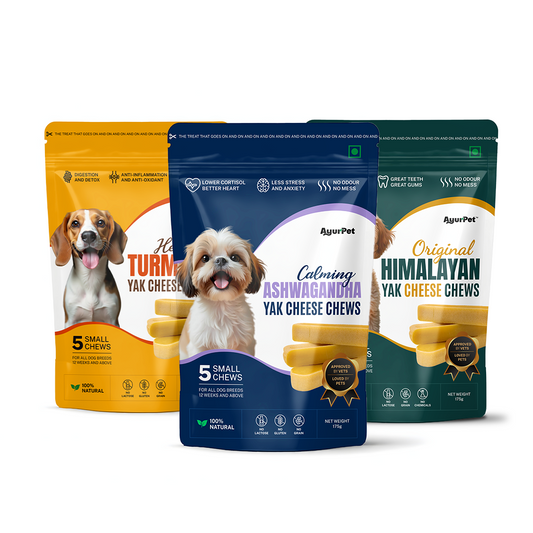
| Yak cheese chews | Himalayan yak cheese chews in Original, Calming Ashwagandha and Turmeric versions | Long-lasting chewing, calm and joints |
AyurPet is trusted by pet parents with more than 9,340 reviews, and our in-house vet, Dr. Amrita (M.V.Sc in Animal Nutrition, 8+ years in animal healthcare), is available for one-on-one consultations.
Quick check
How many new products should you add at a time?
Show the answer
One. Add one product at a time and keep a simple diary of the signs you care about.
6Chapter 6 of 7
Staying safe
Natural is a source, not a safety rating.
- What never to give your pet
- How cats differ from dogs
- How to judge a claim or a label
Some plants that suit people are dangerous for pets, and cats are different again. This chapter covers what to avoid, what to check on a label and how to tell a real study from a big promise, so you can choose with confidence.
6.1Safety first: what every pet parent should know
Read more: cats, quality, medicines and when to call the vetShow less
- Cats are different. Cats have a reduced ability to break down many plant compounds, so herbs and oils that suit dogs can harm cats. Never give a dog product to a cat.
- Quality matters. A US study of Ayurvedic products sold for people found that about one in five contained lead, mercury or arsenic above daily limits. Choose products with batch testing for heavy metals and no metal-based preparations.
- Herbs can interact with medicines. Research on herb and drug interactions in pets is still thin, so always tell your vet what you give.
- Some herbs need extra care. Neem oil should not be used on cats. Guduchi (giloy) has human liver-safety reports. Licorice can affect blood pressure and potassium in people.
- See your vet straight away if your pet vomits, has diarrhoea for more than a day, stops eating, seems weak, or you think it ate something toxic.
6.2The home herb safety checklist
Eight questions to ask before you give your pet any herb or supplement. Tick each one as you go.
6.3Ayurveda for cats: what is different
Ayurveda is used for cats too, but cats are not small dogs. Their liver has a reduced ability to process many plant compounds (a pathway called glucuronidation), which is why a herb or oil that suits a dog can build up in a cat.
- Ayurvedic routine suits cats well: regular meals, fresh water, play, rest and a calm space are the heart of it.
- Herbs need a vet's guidance: give a cat a herb only if your vet agrees, in a product made for cats.
- Avoid for cats: neem oil, tea tree oil and other concentrated essential oils, and all lilies.
- AyurPet products are made for dogs. Don't give them to your cat.
6.4How to read the evidence
Search "herb for dogs" and you will find big promises. Here is how to judge them.
Read more: five questions to ask of any claimShow less
- Was it studied in dogs or cats? Results in people, rats or test tubes don't automatically apply to pets.
- Was there a comparison group? Studies with a placebo group are stronger than "we gave it to dogs and they improved".
- How many animals? A study of 20 dogs is a start, not proof.
- Was it the herb alone, or a blend? Many pet studies test combinations, so you can't credit one ingredient.
- Who made the claim? A brand's blog (including ours) is not the same as a peer-reviewed journal. We link to our sources so you can check.
6.5How herbal pet supplements are regulated where you live
This is why AyurPet only ever talks about supporting wellbeing. In most countries, a product that makes disease claims is a medicine and needs a licence. Supplements may only support everyday wellbeing.
Read more: the rules in the US, UK, Canada, Australia and the UAEShow less
Animal supplements are regulated by the FDA Center for Veterinary Medicine, mostly as animal food. Disease claims make a product a drug. FDA The industry NASC quality seal shows a company passed NASC audits; it is not a government approval. NASC
The Veterinary Medicines Directorate classes products that make medicinal claims about disease as medicines, whether herbal or not. VMD VMD adverts
Low-risk veterinary health products, including many herbal products for pets, go through Health Canada's notification programme before sale. Health Canada
The APVMA regulates herbal remedies as veterinary chemical products, with specific labelling rules for complementary products. APVMA
Federal Law No. 9 of 2017 regulates veterinary products, with registration through the Ministry of Climate Change and Environment. Khaleej Times
Quick check
Which of these should never be given to dogs or cats?
Show the answer
Garlic. Garlic is on the never-give list. The ASPCA lists fennel as non-toxic, and plain pumpkin is fine, but never pie filling.
7Chapter 7 of 7
Your questions
The questions pet parents ask us most.
- Straight answers to the questions pet parents ask most
- How to search the questions
- Where every source lives
Short, honest answers, each one in line with the research above. If your question is about your own pet's health, your vet is always the best person to ask.
7.1Ayurveda and herbs for dogs and cats: your questions answered
🌱Getting started
What is Ayurveda for pets?
Ayurveda for pets applies Ayurveda, India's traditional system of health, to dogs and cats. It focuses on good digestion, a steady daily routine, diet and well-chosen herbs to support everyday wellbeing, alongside your vet.
Is Ayurveda good for dogs?
Ayurveda can support a dog's everyday wellbeing through routine, diet and herbs. Its best-known herbs, such as ashwagandha, turmeric and boswellia, have active compounds tested in human clinical trials, and ashwagandha has been tested in controlled trials in dogs.
Which herbs can I give my dog at home?
The kitchen herbs pet parents use most are turmeric, ginger, fennel and plain pumpkin, in small amounts. Garlic, onion, chamomile tea and essential oils are ones to avoid. Our home remedies table in the Herb Library chapter lists the safety facts for each.
Is Ayurveda the same as seeing a holistic vet?
No. Ayurveda is a traditional health system; a holistic or integrative vet is a qualified veterinarian who may use herbs alongside conventional care. If you want to use herbs seriously, a vet with herbal training is the safest guide.
😟Anxiety and calm
What can I give my dog for anxiety naturally?
Start with routine, exercise, a safe den and chewing, which help most dogs. Ashwagandha is the Ayurvedic herb with the most research, including small controlled trials in dogs. Talk to your vet if anxiety is severe or sudden.
Does ashwagandha work for dogs?
Three small randomised controlled trials in dogs have looked at ashwagandha for stress, healthy ageing and gut health, and a human trial found it lowered cortisol. The research is promising but still small, so use a pet-made product and check with your vet.
Is chamomile safe for dogs?
The ASPCA lists the chamomile plant as toxic to dogs and cats, with signs such as skin irritation, vomiting and, with long-term use, bleeding problems. Don't give homemade chamomile tea; if a pet product contains it, follow the label and ask your vet.
Can I use lavender or other essential oils to calm my dog?
Concentrated essential oils can poison pets, and cats are especially at risk. Avoid putting oils on your pet or diffusing them in small rooms they can't leave.
How long do natural calming supplements take to work?
It varies. Many owners give a daily product for a few weeks before judging it, and start before known stressors such as fireworks. Keep a diary of signs so you and your vet can see a pattern.
🦴Joints and mobility
Is turmeric safe for dogs?
Turmeric is widely used in dog products, and curcumin has been studied in dogs with joint problems. It can add to bleeding risk with some anti-inflammatory drugs and too much can upset the stomach, so check with your vet first.
What is golden paste for dogs, and is it safe?
Golden paste is turmeric cooked with water, a fat and black pepper to help absorption. Many owners use it, but there is no agreed dog dose. Start very small, and talk to your vet, especially if your dog takes medicine.
Is boswellia safe for dogs?
Boswellia has been looked at in an open study of dogs with joint and spinal conditions, and in a placebo-controlled human knee trial. It is used in many joint products; ask your vet if your dog takes other medicines.
Can turmeric replace my dog's pain medication?
No. Never stop or swap a prescribed medicine without your vet. Herbs may support comfort alongside your vet's plan, but they are not a replacement.
🌿Digestion
What can I give my dog for an upset stomach at home?
For mild diarrhoea under 24 hours in a dog who otherwise seems well, PDSA describes a short, plain, bland diet with white rice for a day or two, then a slow return to normal food. Ask your vet which bland food suits your dog. Call your vet if your dog seems unwell, there is blood, or it doesn't settle.
Can dogs have ginger?
Small amounts of ginger are used for queasy tummies, and a lab study in dogs found ginger extracts reduced vomiting. Ginger can affect blood clotting, so tell your vet, especially before surgery.
Is pumpkin good for dogs with diarrhoea?
Plain cooked pumpkin is a common source of fibre for mild stool changes. Never use pie filling or sweetened products, which can contain xylitol.
Is fennel safe for dogs and cats?
The ASPCA lists fennel as non-toxic to dogs and cats. Keep amounts small and keep concentrated fennel oil away from cats.
When should I take my dog to the vet for diarrhoea?
Go to the vet if there is blood, your dog is vomiting, seems weak or in pain, stops eating, or it lasts more than a day. Puppies, older dogs and dogs on medication need help sooner.
🐾Skin and coat
Is coconut oil good for dogs?
Small amounts are unlikely to cause serious harm, but coconut oil can cause stomach upset and loose stools. Coconut water should not be given to pets.
Is neem oil safe for dogs?
Neem is traditionally used for skin, mostly in diluted pet products. It should never be used on cats, as poisoning cases have been reported.
Why is my dog so itchy?
Common causes include fleas, allergies and skin infections. A vet visit is worth it for itching that disturbs sleep, causes sores or hair loss, or doesn't settle.
🐈Cats
What herbs are safe for cats?
Very few herbs have been studied in cats, and cats process many plant compounds slowly. Fennel is listed as non-toxic by the ASPCA. Give a cat any herb only with your vet's agreement.
Can cats have turmeric or ashwagandha?
There is very little research in cats. Don't give a cat a dog or human product; ask your vet about a cat-specific option.
Are essential oils safe for cats?
No. Cats are especially sensitive to concentrated essential oils, including tea tree oil, on the skin or in diffusers.
Is garlic safe for cats?
No. Garlic and onion damage red blood cells, and cats are more sensitive than dogs.
🛡️Safety and buying
Is garlic good for dogs?
No. Despite its use as a 'natural' remedy, garlic is toxic to dogs and cats and can damage red blood cells.
Can I give my dog human ashwagandha or turmeric capsules?
It's not a good idea. Human products are dosed for adults and can contain xylitol or other ingredients that are unsafe for dogs. Use a product made for pets.
Are herbal pet supplements regulated?
Yes, but differently in each country. In the US they are mostly regulated as animal food, in the UK any disease claim makes a product a medicine, and Canada, Australia and the UAE have their own systems. See the regulation notes in the Staying safe chapter.
How do I choose a safe herbal supplement for my pet?
Look for a pet-specific product with every ingredient and amount named, batch testing for heavy metals, no xylitol or essential oils, and honest 'supports' wording rather than disease claims. Then run it past your vet.
7.2Sources and further reading
All 39 sources behind this guide, from clinical trials to veterinary manuals.
- Kaur et al. 2022: ashwagandha root extract and stress and anxiety in dogs, randomised controlled trial (FAO AGRIS record)
- Bharani et al. 2024: ashwagandha in healthy older dogs, randomised placebo-controlled trial (PubMed)
- Bharani et al. 2025: ashwagandha and gut parameters in dogs, Frontiers in Veterinary Science
- Comblain et al. 2017: curcuminoids, collagen and green tea in dogs with osteoarthritis, BMC Veterinary Research (PubMed)
- Reichling et al. 2004: boswellia resin in dogs with joint and spinal conditions (PubMed)
- Chandrasekhar et al. 2012: ashwagandha root extract and stress in adults, randomised placebo-controlled trial (PMC)
- Daily, Yang and Park 2016: turmeric and curcumin for joint arthritis, meta-analysis of randomised trials (PMC)
- Kimmatkar et al. 2003: boswellia extract in knee osteoarthritis, randomised double-blind placebo-controlled trial (PubMed)
- Peterson, Denniston and Chopra 2017: therapeutic uses of Triphala in Ayurvedic medicine (PMC)
- Kongkeaw et al. 2014: meta-analysis of randomised trials on the cognitive effects of Bacopa monnieri (PubMed)
- Sharma et al. 1997: ginger against chemotherapy-induced vomiting in dogs (PubMed)
- Merck Veterinary Manual: herbal medicine in animals
- Merck Veterinary Manual: common botanical products in veterinary medicine
- MSD Veterinary Manual: toxicoses from essential oils in animals
- Tea tree oil poisoning in 443 dogs and cats (PubMed)
- Cornell University College of Veterinary Medicine: small animal toxins
- US FDA (archived): Ayurvedic products and heavy metals
- Tulsi in humans: systematic review (PMC)
- Guduchi (giloy) and liver injury case review, Cureus 2023 (PMC)
- Pushpangadan et al.: traditions of veterinary practice in India, including Hasti Ayurveda (JNTBGRI)
- Edicts of Ashoka (World History Encyclopedia)
- Merck Manual: Ayurveda
- UK VMD: check if your animal treatment is classed as a medicine
- US FDA: animal food and feed product regulation
- Sutton, Bates and Campbell 2009: neem oil exposure in cats, Veterinary Record
- Watson et al. 2024: glycyrrhizin safety in dogs, Journal of Animal Physiology and Animal Nutrition (PubMed)
- ASPCA: Chamomile (toxic and non-toxic plants)
- ASPCA: Fennel (toxic and non-toxic plants)
- ASPCA: People foods to avoid feeding your pets
- Merck Veterinary Manual: Allium (onion and garlic) toxicosis in animals
- Merck Veterinary Manual: Herbal medicine in veterinary patients
- US FDA: Paws off xylitol, it's dangerous for dogs
- PDSA: Gastroenteritis (stomach upset) in dogs
- PDSA: Diarrhoea in dogs
- UK VMD: Advertising non-medicinal veterinary products
- National Animal Supplement Council (NASC)
- Health Canada: Veterinary health products
- APVMA: Labelling requirements for complementary products
- Khaleej Times: UAE issues law for regulation of veterinary products
This guide is for general information about Ayurvedic herbs and pets. It is not veterinary advice and does not diagnose, treat or prevent any condition. Always talk to your vet before giving your pet a new supplement, especially if your pet is young, old, pregnant, unwell or on medication.
Quick check
Where does Ayurveda fit alongside your vet?
Show the answer
It supports everyday wellbeing alongside your vet. Ayurveda is about everyday support and routine, and pain, vomiting or not eating need your vet first.
Your next step
However much you read, here is where to go from here.
Get a plan for your pet
Talk to your vet before starting any new supplement. AyurPet also offers online consultations with a vet about diet, digestion, joints and behaviour.
Book a vet consultationShare this guide
Know a pet parent who would like it? Send them the guide.
Start with the formula for your pet's need
A good place to start: the products readers pick most often from this guide.
CoolCalm+ calming dropsSee CoolCalm+ →Calming Ashwagandha Yak Cheese ChewsSee the calming chews →HipOJoint joint dropsSee HipOJoint →Turmeric Yak Cheese ChewsSee the turmeric chews →GoodGut+ digestive dropsSee GoodGut+ →Gut, Calm and Joint TrioSee the trio →Original Himalayan Yak Cheese ChewsSee the original chews →
This guide is for general information about Ayurvedic herbs and pets. It is not veterinary advice and does not diagnose, treat or prevent any condition. Always talk to your vet before giving your pet a new supplement, especially if your pet is young, old, pregnant, unwell or on medication.